

You're running a business, juggling everything, and what you really want is more customers. Branding can feel like something for the big end of town. And now AI marketing promises a logo, a tagline and a month of posts in an afternoon. Fast, cheap, done. But brands built that way often end up sounding like everyone else, and fixing that later costs far more than doing it right the first time.
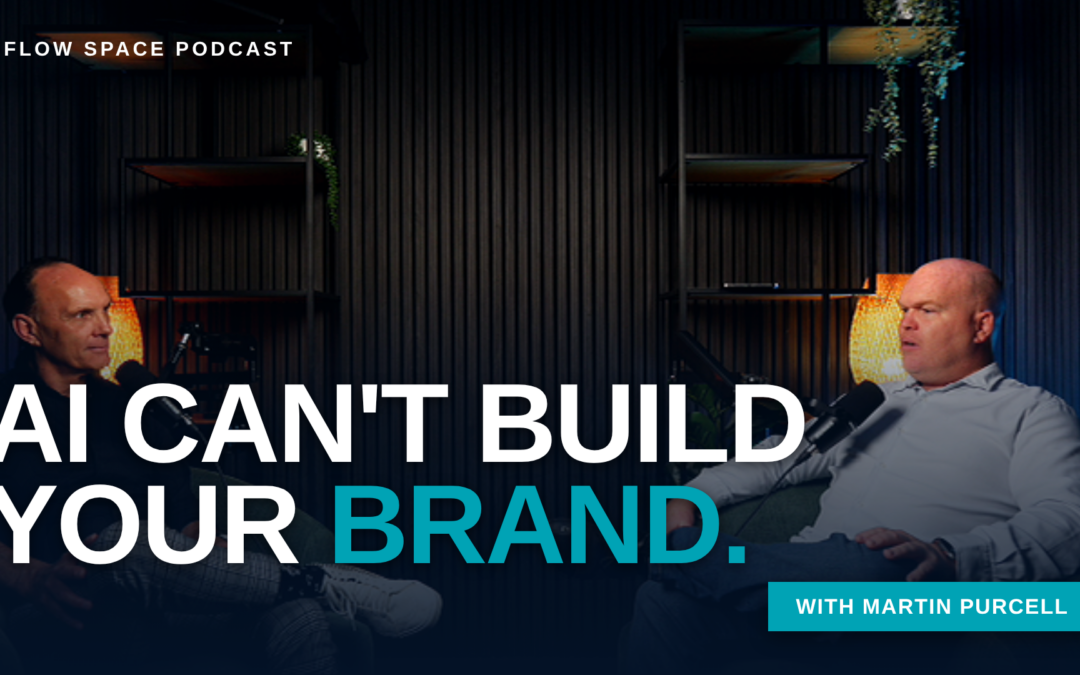
So is AI the problem? Not really. It's the order we use it in. That was the message when brand strategist Martin Purcell, who has spent about 25 years in brand and marketing strategy, joined Noel Germishuizen on the Flow Space Podcast. The human work has to come first. Skip it, and no tool can make up the difference.
TL;DR Quick Answers
Why does AI marketing all sound the same?
- AI tools rebuild content from patterns that are already online, so a brand with no clear core gets the same safe, average messaging as everyone else.
- The fix for AI marketing is order, not avoiding AI: do the human brand strategy work first (discover and define who you are), then let AI scale it.
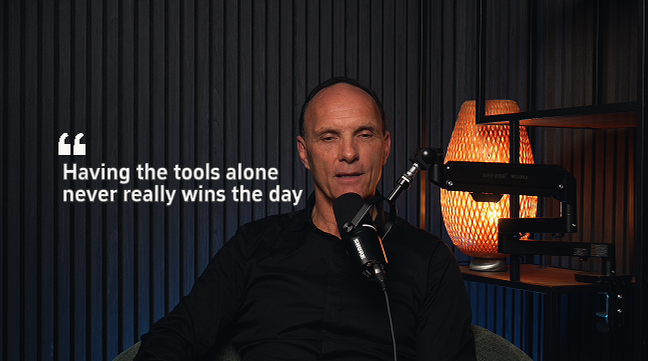
- Brand strategist Martin Purcell's rule: "Having the tools alone never really wins the day."
Why AI marketing makes every brand sound the same
AI writing and design tools are pattern machines. They produce the most likely answer based on what's already online. Ask one for "a friendly tagline for a local accounting firm" and you'll get a polished line. Ask again for your competitor, and you'll get nearly the same one.
That's fine for a shopping list. For a brand, it's a problem, because a brand only works if it's different. As more businesses lean on the same tools, the market drifts towards the same safe words, the same stock-style images and the same promises.
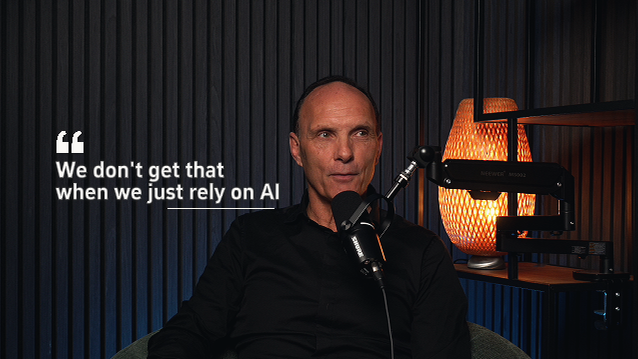
"We don't get that when we just rely on AI. In fact, we get a very contained and constructed and very constrained framework on the information." – Martin Purcell, brand strategist
Two more things make it worse:
- Garbage in, garbage out, or at best, average in, average out. Much of what's online is mediocre, and that becomes the ceiling for anything built on it.
- AI sounds sure of itself. A weak idea arrives in the same confident tone as a strong one. Noel puts it bluntly: AI "will take you down a path very, very confidently," and once you've followed it, it's hard to turn back.
Without a clear core, every campaign pulls in a different direction, something Martin calls brand schizophrenia. It may look fine today, but in five to 10 years, Noel warns, "the cracks are really gonna show." People are getting better at spotting content no human cared about, and once they notice, that trust is hard to win back.
What AI can't do for your brand
A brand isn't your logo. It's what you stand for, how you sound and what customers can count on. Working that out takes four things no tool can supply.
1. Real conversations. Good brand strategy starts by talking to the owner, the team and the customers, and listening for what they don't say. "What AI doesn't have is that human nuance," Martin says. No chatbot can sit across the table from a founder and notice what makes them light up.
2. Original ideas. Ask AI to advertise a car's parking feature, and you'll get a shiny car parked neatly by the kerb, because that's what most parking ads look like. Volkswagen's "Hedgehog and Fish" ad for Park Assist by DDB Tribal Berlin did something no average could: a spiky animal parked perfectly between goldfish in plastic bags. No car, no spec list, and people still remember it.
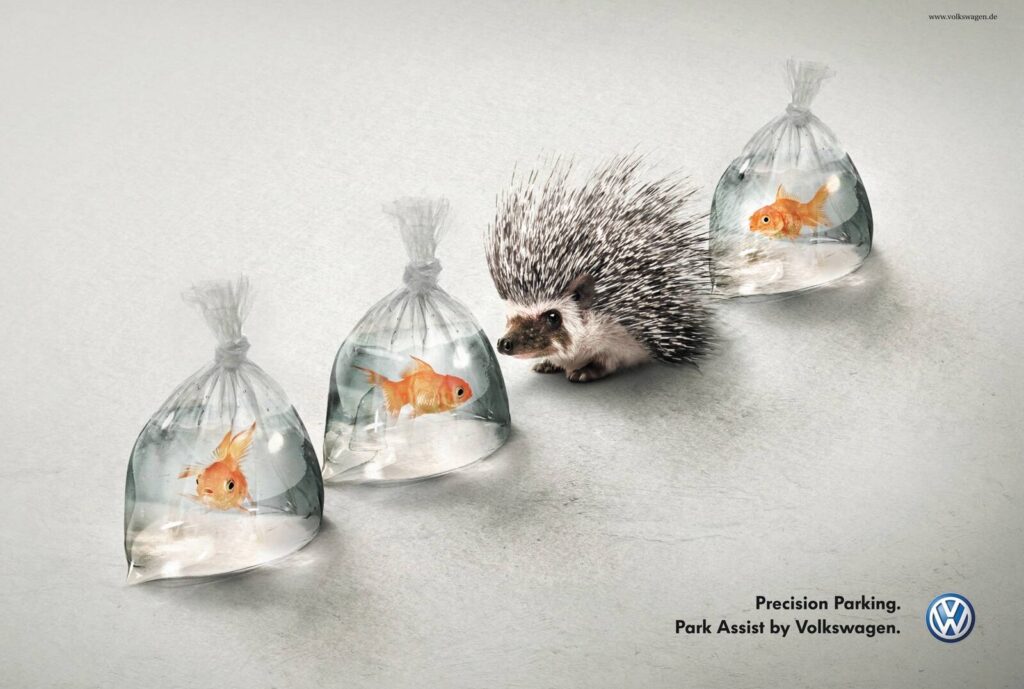
"Precision Parking. Park Assist by Volkswagen." Ad by DDB Tribal Berlin for Volkswagen, 2012.
3. Someone who pushes back. AI marketing tools tend to agree with whatever you suggest. A good strategist questions your brief and puts your results ahead of your first instincts. "I'm not here to be a yes man," as Martin puts it.
4. Genuine care. People can tell when nobody really thought about them. Martin notes that when a personal note or a client's birthday message is written by AI, "it actually diminishes the perception of value in that person sending it." It's the same with customer service. Most of us have typed "speak to a real person" into a chatbot at least once. When people want help, they want someone who actually cares about fixing it.
"As we get more and more AI happening, the human touch is gonna be critical." – Martin Purcell
Those conversations should answer three questions, which Martin calls positioning, persona and promise:
- Positioning: Who are you, and what do you stand for?
- Persona: How do you sound and look? Loud or quiet, playful or conservative?
- Promise: What can customers count on, every time?
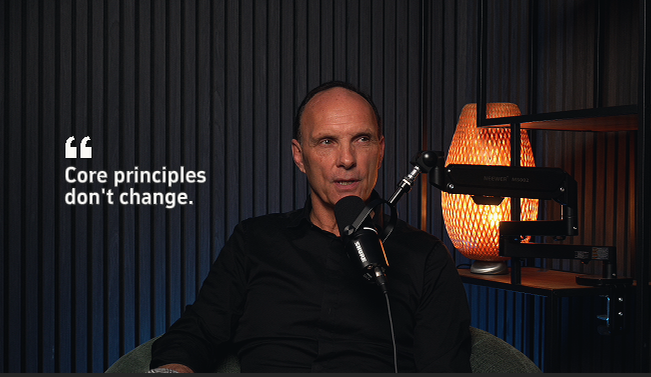
Get the brand strategy fundamentals right first: the 4 Ds
Most business owners start with the logo and colours. Martin calls that branding "from the outside in rather than the inside out," and it's why so many rebrands don't stick. His four-stage process works the other way. Use these questions to start on your own business.
- Discover. Talk to people and look around before deciding anything.
- Why did you start the business, and what still excites you about it?
- Who are your best customers, and why do they choose you?
- Who else could they choose, and how do those competitors describe themselves?
- Define. Turn what you learned into a clear position.
- What's the one thing you want to be known for?
- What do you do differently, and can you prove it?
- What will you say no to?
- Design. Only now: the logo, colours, tone of voice and templates.
- Does every element reflect your positioning, persona and promise?
- Deploy. Roll it out consistently.
- Is the same message on your website, socials, signage and proposals?
- Does your team know how to talk about the business?
AI marketing tempts businesses to jump straight to steps three and four. But discovery often finds what nobody was looking for. Martin once worked with an architect whose 10-step client process felt like "an ordeal" to clients. Discovery turned it into four clear stages. A chatbot would never have spotted the problem, because the architect didn't see it either.
Slowing down is a hard sell, and Noel knows it: "If I say the word slow down, I can feel people freaking out." Yet brands built in a hurry often get redone three or four times, which costs far more than doing it properly once. The same goes for AI itself. Martin sees "high levels of failure in AI implementation into business," because companies skip the thinking first. "If you don't have clarity, then you're going to make a lot more mistakes."
His advice is simple: "let's do this once and let's do it right."
Is your brand ready for AI marketing? A quick check. Before you hand your marketing to a tool, make sure you can tick every box:
- ☐ I can explain what my business stands for in one sentence.
- ☐ I know who my best customers are and why they choose me over competitors.
- ☐ I know how my brand should sound, and how it shouldn't.
- ☐ My logo, colours and messages all say the same thing.
- ☐ I have a short brand guide that a new staff member, or an AI tool, could follow.
- ☐ Someone who knows the brand checks everything before it goes out.
If you can't tick most of them yet, that's your starting point, not the AI tool.
Where AI earns its place in your marketing
None of this means leaving AI marketing tools out. Once your strategy is set, they become a powerful ally, because now they have something solid to work from.
"If you have a very solid footing in a certain industry, that domain expertise that you have, it will amplify it." – Martin Purcell
Martin goes one step further and builds a "brand vault" for his clients: brand language guides, tone examples, templates and style elements, all in one place for AI to draw from. Get it right once, and you have what he calls a reservoir of intelligence "that then gets it right all the time, 24/7."
How to use AI in marketing responsibly
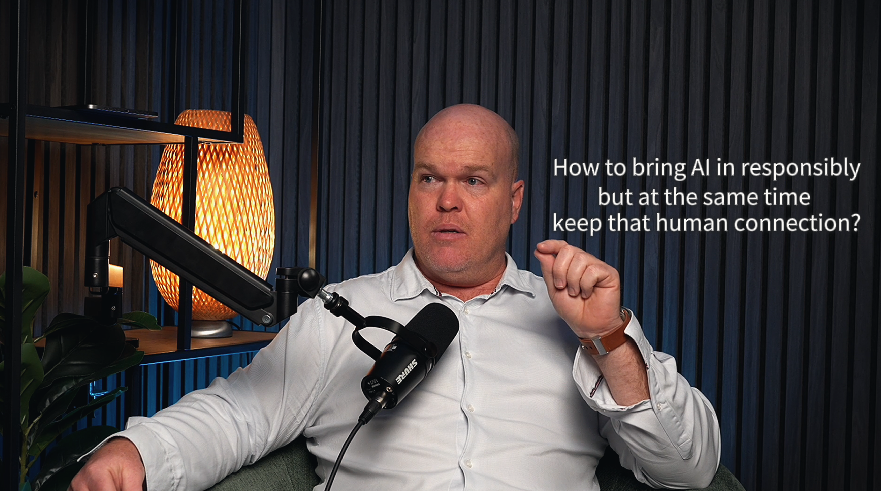
The real question, as Noel frames it, is how to "bring AI in responsibly" and still keep the human connection.
Five rules make that practical:
- Know enough to judge the output. "If you don't know how to actually assess what's delivered back to you," Martin says, "then you'll end up just selecting something that doesn't suit." He could hand you forceps and a scalpel, but you wouldn't do your own knee surgery. "Having the tools alone never really wins the day."
- Be upfront about AI. If AI wrote it, say so. It should be clear when AI is doing the work and when a human is, or it starts to feel disingenuous.
- Keep customer data out of public AI tools. Treat anything you paste into a chatbot as if it could be seen by others.
- Follow the same advertising rules. AI-made ads face the same codes as any other, and the business is still accountable.
- Keep a human sign-off. Nothing goes out under your name until someone who knows your brand has read it.
The resources further down explain rules 3 and 4 in detail for Australian businesses.
Even if machines keep getting smarter, as Elon Musk has predicted, Martin believes taste and nuance are "still not there." The bigger reason is us. "We're wired biologically differently," he says, "and we still crave that sense of human connection." Science backs him up. The Harvard Study of Adult Development, which has followed people for more than 85 years, found that close relationships, more than money or fame, keep people happy and healthy. A brand that sounds like a real person speaks to that need. One that sounds like a machine can't. Noel's advice to business owners sums it up:
"Slow down and find someone with passion."
AI marketing by the numbers
The data backs up what Noel and Martin hear from business owners every week.
- Your competitors' content is increasingly AI-made. 43% of Australian small and medium businesses used AI between December 2025 and February 2026, and content generation was the top use, at 54% of adopters (National AI Centre). When half the market writes with the same AI marketing tools, sameness is the default.
- Trust is lagging behind use. Only 36% of Australians say they are willing to trust AI, and 77% believe it needs regulation (University of Melbourne and KPMG, 2025). That's why being upfront about AI, as rule 2 above suggests, protects a brand.
- People fear losing the human part. 53% of US adults expect AI to make people worse at creative thinking, and 50% expect it to weaken people's ability to form meaningful relationships (Pew Research Center, survey of 5,023 adults, June 2025). Creativity and connection are exactly what brand strategy is built on.
Essential resources on AI marketing
Ready to bring AI into your marketing without losing your brand? Start with these seven.
1. Write for people, not for algorithms
Google Search's guidance about AI-generated content (Google Search Central) explains that Google rewards helpful, people-first content however it's made, and penalises content made mainly to game rankings.
2. Follow six practices for adopting AI safely
Guidance for AI Adoption (National AI Centre, October 2025) sets out six essential practices for Australian organisations, from first steps to scaling up.
3. Check your AI use against eight ethics principles
Australia's AI Ethics Principles cover human-centred values, transparency, privacy and accountability: a quick test for any AI marketing plan.
4. Keep customer data out of public AI tools
Guidance on privacy and the use of commercially available AI products (OAIC) shows how to vet AI tools and why personal information shouldn't go into public chatbots.
5. Remember the advertising rules still apply
New tech, same rules (Ad Standards, June 2025) makes it clear that AI-generated ads face the same codes as any other, and the advertiser is accountable.
6. Get your team talking about AI first
The AI conversation guide for small business helps owners pick the right tasks for AI, test small and address staff concerns. It's discovery, Martin-style.
7. Find practical help in Western Australia
The Small Business Development Corporation's AI page gives Perth and WA businesses plain-English advice on AI tools, checking outputs and writing an AI policy.
Final thoughts: AI marketing needs a human first step
AI marketing isn't the problem. Skipping the thinking is.
At Flow Space, we see the same thing every week in the studio and around the coworking floor. The businesses whose content feels most like them are the ones who know what they stand for before they open a tool.
- Use AI marketing tools for speed once your positioning, persona and promise are clear.
- Keep a human in charge of the decisions that make you different.
- Pay for the push-back. A strategist who questions your first instinct saves you the cost of a rebrand later.
Top takeaways
- AI marketing sounds the same because AI learns from what's already out there.
- Brand strategy works from the inside out: positioning, persona and promise come before logos and colours.
- Follow the 4 Ds in order: discover, define, design, deploy.
- AI amplifies expertise; it doesn't replace it.
- Rushing costs more than doing it once and doing it right.
FAQ on AI marketing
Q: What is AI marketing?
A: Using AI tools to create, plan or analyse marketing, such as copy, images, social posts and reports. It's fast, but it only works well when the brand behind it is already defined.
Q: Why does AI marketing content sound the same?
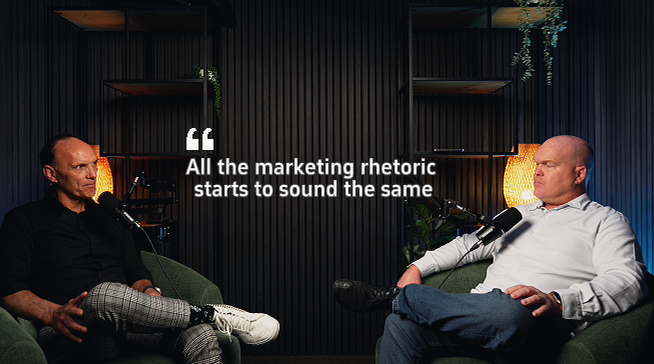
A: AI learns from content that already exists online. Without a clear brand core, it produces the same safe, average messaging competitors get, and "all the marketing rhetoric starts to sound the same."
Q: Should brand strategy come before AI marketing?
A: Yes. Discover and define your positioning, persona and promise first. Then design and deploy, using AI to scale what you've decided.
Q: How can a business use AI in marketing responsibly?
A: Know your market well enough to judge what AI gives back. Be open about when AI wrote something. Keep personal information out of public AI tools.
Q: Can AI replace a brand strategist?
A: Not yet. AI agrees with you; a strategist pushes back. As Martin says, "I'm not here to be a yes man."
Watch the full episode of the Flow Space Podcast
Martin Purcell is a brand strategist who helps businesses get clear on their positioning, persona and promise before anything gets designed or automated. Connect with Martin on LinkedIn.
Hear the whole conversation on AI marketing and brand strategy on the Flow Space Podcast. Want to record your own? Book the Flow Space podcast studio in North Beach, or explore coworking memberships.
Related read: Yes to Everything Until You Make It: RT Builders’ Story, how Sophie and Riley Thwaites built a business together by saying yes to everything.