

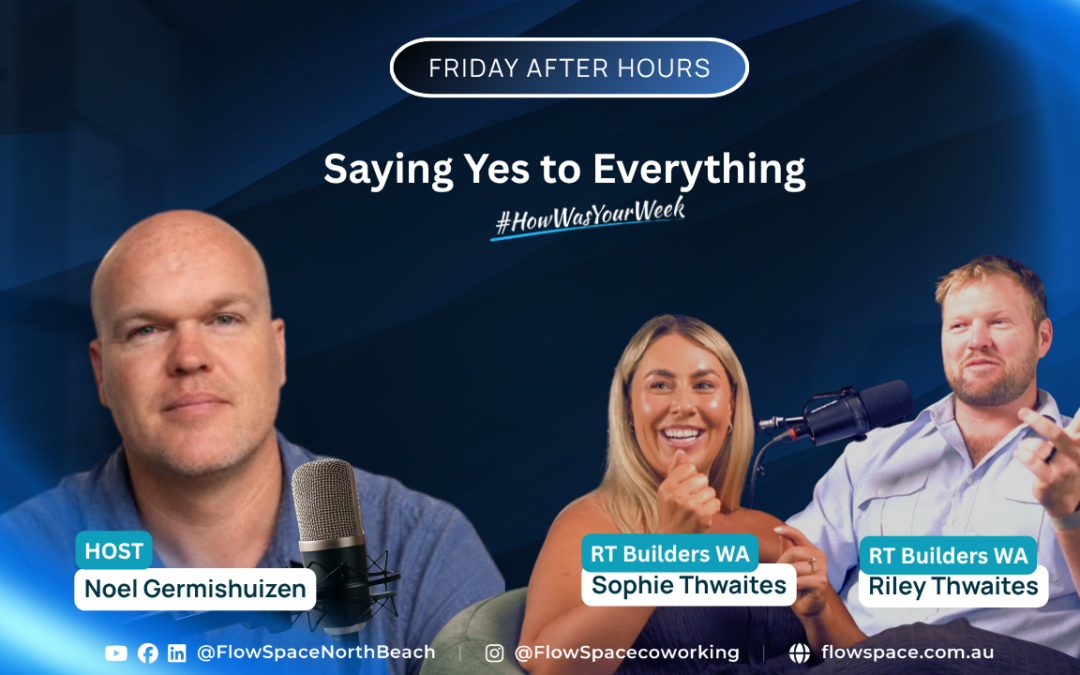
Say yes to everything until you make it. That was Sophie and Riley Thwaites' rule when they started RT Builders in 2020, with no big builds waiting and the rest to figure out afterwards. Running a business as a couple has been part of the story since day one: your business partner is also the person you go home to.
Six years on, RT Builders builds homes and commercial projects across Perth and Exmouth, WA. On Friday After Hours at Flow Space coworking in North Beach, Perth, host Noel Germishuizen asked them what starting a business from the ground really takes, how they grew it, and how they make it work as a couple. Their answer comes back to one idea: the best investment you'll ever make is in your partner.
TL;DR Quick Answers
What does running a business as a couple really take?
- Say yes early. Small jobs build income, skills and referrals. Figure out the rest as you go.
- Balance each other. One partner pushes to go, the other knows when to slow down.
- Invest in each other. Business is hard most days, so the person you build with matters most.
Meet Sophie and Riley Thwaites of RT Builders
Riley is the builder. He grew up on the tools and always wanted his own building company. Sophie had no background in construction or business when they started, but she's learned the industry inside out and runs the organising, the client relationships and, by her own admission, Riley.
They've been together for more than 10 years and married in April this year. They split their life and business between Perth and Exmouth, a remote town about 13 hours' drive north, where they took what they call a leap of faith and started building. As Sophie puts it, their life is "far from normal", but they enjoy it.
Lesson 1: Say yes to everything when you're starting a business
Riley started just before Covid, at a time when plenty of builders were getting out of the industry. His dad gave him advice that stuck: if you can survive now, you'll be able to survive later on.
The early work wasn't glamorous. RT Builders took on maintenance jobs, fixed doors, redid gutters and got bank-repossessed houses ready to go back on the market. Some nights they were cleaning at 10 o'clock so they could make the handover the next morning, with Sophie stopping for takeaway on the way to help.
"We put our hand up for anything, and I mean like anything. We said yes to anything." Riley Thwaites
Sophie made it the rule for the business. "Let's just say yes to everything, and whatever happens, happens," she said. "And it took us to so many different journeys and opportunities."
People questioned it. Why would a builder with a building licence want to do maintenance? Riley saw it differently: "You never knew whose house you were going to." A homeowner happy with a new gutter might mention a friend, their kids or their parents, who needed a deck renovation or an extension.
Saying yes meant backfilling later, as Riley put it. You take the job, then work out how to deliver it. That's how most small businesses really start: not with a perfect plan, but with a willingness to show up.
Lesson 2: Your network is your first client list
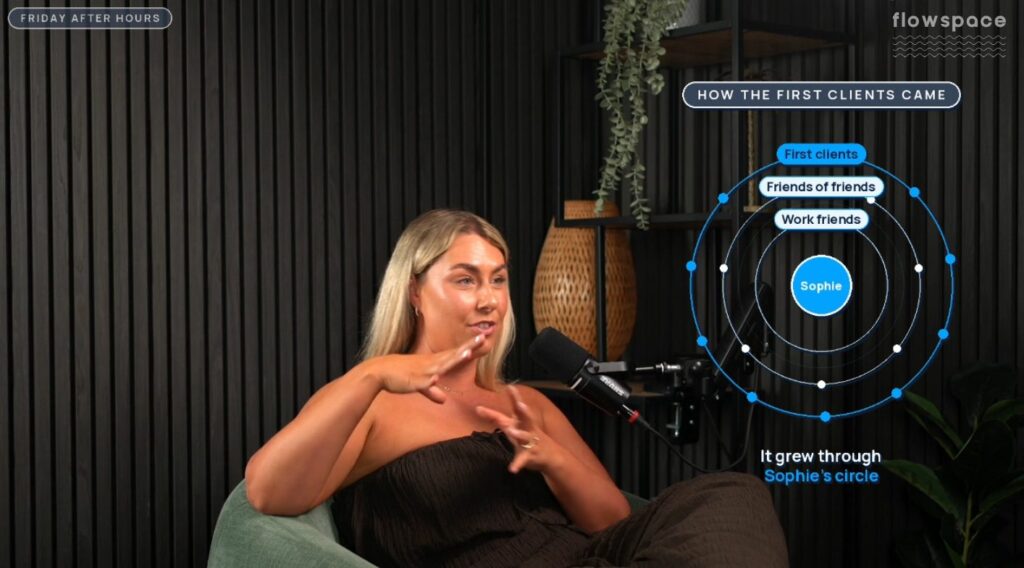
The other half of saying yes was saying it to the people around them. RT Builders' first clients didn't come from ads. They came from Sophie's circle: friends, family, work friends and friends of friends.
"There was a lot of people in my circle that took a trust in us and loved us as people." Sophie Thwaites
One of Riley's first jobs was a deck for Sophie's parents. Word spread from there. As they said on the show, Perth is the biggest small town around: when people know you, trust you and see you do good work, the next job often comes through them.
Noel summed up what it takes to keep going with a simple framework he calls EMS: education, motivation and support. "Your support is huge. Motivation is fleeting," he said. So you build an environment that keeps the motivation coming, and you keep learning as you go, just like Riley did, starting with renovations before building whole houses.
Lesson 3: Figure it out as you go, then deliver
Saying yes is the easy part. Then you have to deliver, often on work you've never done before.
In the early days, Riley picked up subcontract roofing work to keep money coming in. He'd get up at 3am in winter, drive to the job, work an eight-hour shift, then squeeze in small jobs of their own in the afternoon. He kept a spare change of clothes in the ute and got changed in car parks before client meetings. When they won their first build in Exmouth, Riley worked on the client's house Monday to Friday and built their own home on the weekends.
They don't call any of it luck. "Riley and I always said we hate the word luck," Sophie said. "I truly believed it was hard work, sacrifice, motivation."
Noel agreed that opportunities only go so far. People might give you a chance, but you have to deliver every time, and the next job comes because you did a good job on the last one. "The more discomfort you can deal with, the more lucky you become," he said.
Riley compared it to a cricketer fielding in the slips: you stay in your spot all day, composed and ready, so that when the chance finally comes, your hands are up to catch it.
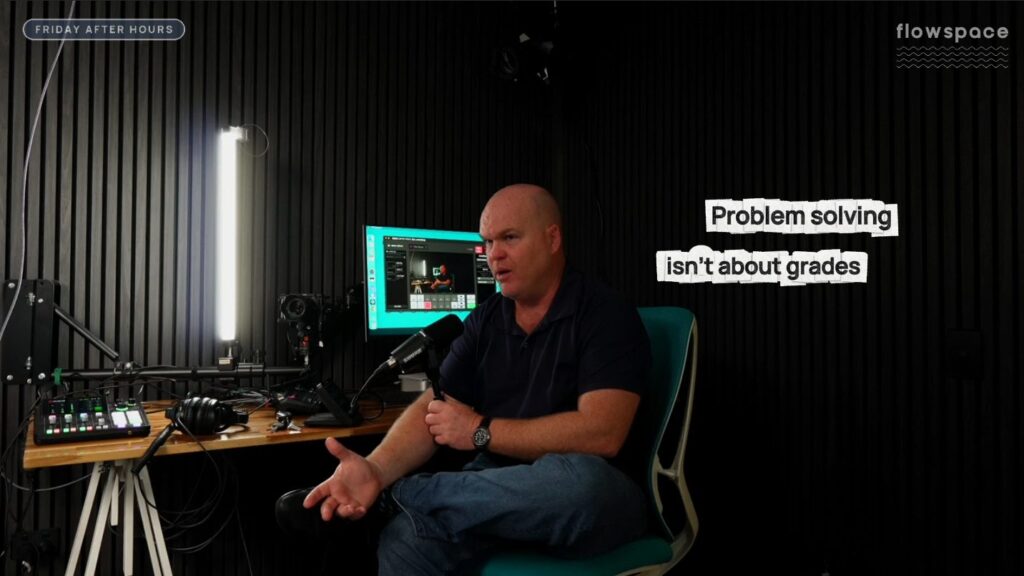
That's also what the trades teach you. No two days are the same, and you're constantly coming up with solutions on the fly. As Noel put it, problem solving and academic marks are two very different things.
And growth doesn't suddenly feel like you've made it. As they put it, progress feels like squashing one fire after the next. Six years in, they're still hustling, just in a way that lasts.
Lesson 4: Running a business as a couple needs a go and a slow
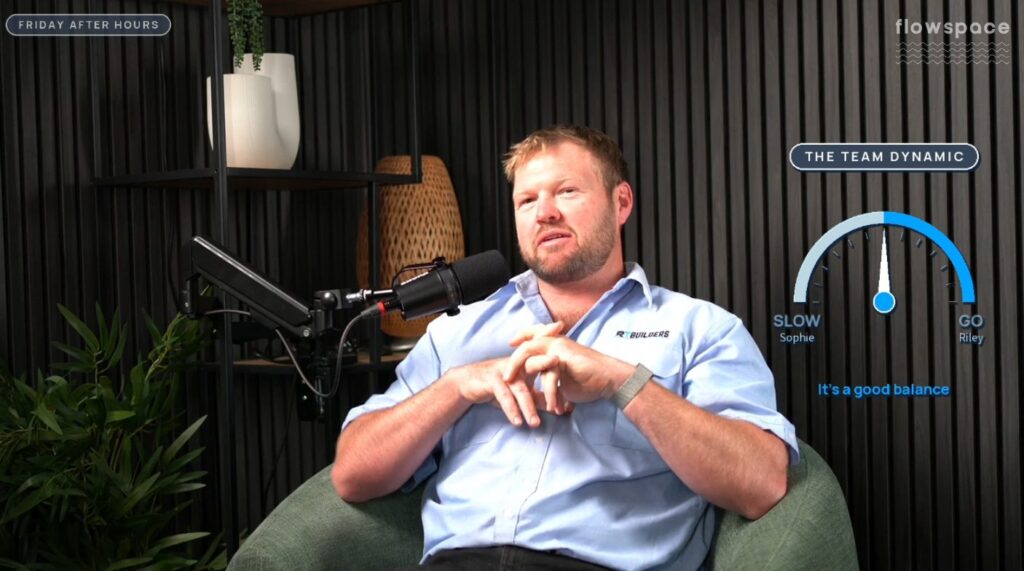
Every business needs drive, and every driven person needs someone who knows when to stop. For RT Builders, that's the two of them.
"He is obsessed with what he does. He loves his work, it's absolutely everything. I'm the person that brings in the, no, that's enough work for now." Sophie Thwaites
Sophie is also the one who books the holidays. Left to himself, Riley admits he'd stay at the office until Sophie called to ask when he was coming home.
"Soph tells me to slow, I tell her to go," Riley said. "It's a good balance."
They made a commitment early on: go hard in the years before they have kids, so they can have more work-life balance when they start a family. Noel called that the important part. Going all in only works when you know it's a window, not forever. He tells young people the same thing: there's a limit to how long anyone can keep that pace before the wheels start to come off.
One cuts, one sews
Riley describes their partnership with a saying he heard years ago: one cuts, one sews. "There's sometimes she'll cut and I sew, and there's times I sew and she cuts," he said. "We're kind of opposite."
It even came up at their wedding. "He's the country guy and I'm the coastal girl," Sophie said. "That is the difference, and we've merged our life together." It works both ways, too: when Sophie is stuck on a problem at work, Riley is the first person she goes to for advice.
Lesson 5: Your partner is your biggest investment
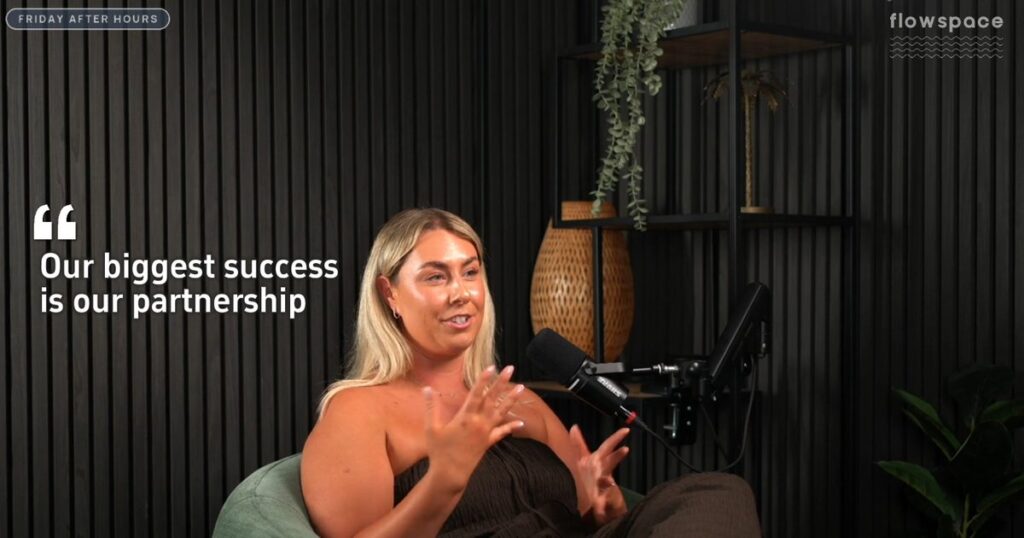
When Noel asked about their biggest success, neither of them talked about jobs or money.
"I don't measure success on financial or business and things that we've done. He's my best friend, so I feel like that's my biggest success: my partnership with my husband." Sophie Thwaites
Riley said exactly the same.
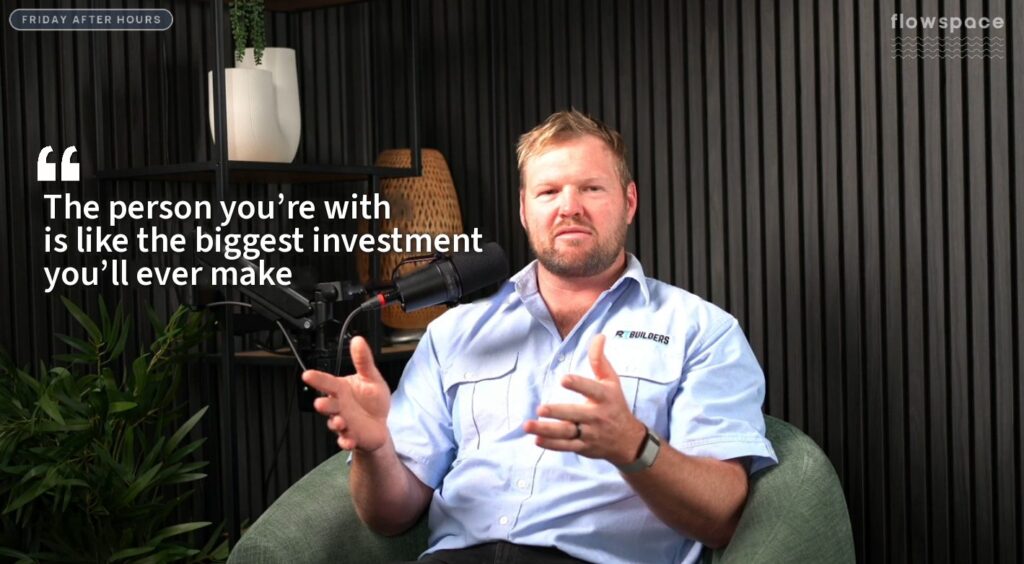
They're honest that it isn't always easy. They argue like any couple, and their life doesn't look like the holiday photos people post online. (Sophie still reminds Riley to pack his shirt before a podcast recording.) That's the point, Riley said:
"You're in the trenches nine times out of 10, and the person you're with is like the biggest investment you'll ever make. Because at the end of the day, it's not all gonna be great." Riley Thwaites
"I wish I'd said it," Noel said. He and his wife Nikki have the same dynamic at Flow Space: backing each other through the years when the business came first, and calling each other out when it's needed. Building something together means leaving ego at the door and remembering you're growing it together.
It honestly is a team effort. As they put it, you can't do it without the people around you.
Running a business as a couple: by the numbers
Sophie and Riley are far from alone.
- Couples are everywhere in small business. Seven in 10 Australian businesses are family owned, and about 40% are run by a couple, according to the Australian Small Business and Family Enterprise Ombudsman (September 2025). Building with your partner is one of the most common ways Australians start a business.
- Plenty of people are taking the leap. 460,461 new businesses started in Australia in 2025-26, an entry rate of 16.9%, while 375,331 closed. Construction businesses grew 3.4% over the year (Australian Bureau of Statistics, August 2026). Starting is common; lasting takes the kind of grit RT Builders talks about.
- The pressure is real. In a national survey of 1,007 small business owners, balancing work, family and personal life was the top source of stress, and 22% had recently been diagnosed with a mental health condition (Treasury, Small Business and Mental Health, December 2022). That's why the partner who says "slow down" matters as much as the one who says "go".
Essential resources for starting a business as a couple
Ready to build something with your partner? Start with these seven.
1. Think it through before you launch
New businesses (business.gov.au) walks you through the practical side of running a business before you start, from business names and locations to costs and legal essentials.
2. Choose the right structure for a couple
Business structures (business.gov.au) explains the options, including partnerships, where two or more people share the income and losses, and what a partnership agreement should cover.
3. Get free advice in Western Australia
The Small Business Development Corporation gives WA business owners no-cost advice on starting and running a business, plus workshops and help with disputes and commercial leases.
4. Register before you build in WA
The Builders' registration guide (Building and Energy, WA Government) explains how building practitioners and contractors apply for and keep their registration.
5. Back the next generation of tradies
The Construction Training Fund's guide to hiring an apprentice covers the business case for taking on an apprentice in WA construction, how to set it up and the funding that can help.
6. Look after the people running the business
NewAccess for Small Business Owners (Beyond Blue) offers free, confidential coaching to help business owners manage stress: six sessions by phone or video, no GP referral needed.
7. Know where to turn when things get tricky
The Australian Small Business and Family Enterprise Ombudsman helps small and family businesses resolve disputes with other businesses and government agencies, and shares tools and data for family enterprises.
Final thoughts: say yes, and choose who you build with
Starting a business doesn't need a perfect plan. It needs a willingness to say yes, and the right person beside you when it gets hard.
At Flow Space, we see it every week around the coworking floor and in the studio. The businesses that last are built by people who back each other, keep showing up and aren't afraid to start small.
- Say yes early, then figure out how to deliver. Small jobs open bigger doors.
- Find your balance. One of you says go, one says slow, and you swap when you need to.
- Invest in your partner. They're the one in the trenches with you nine times out of 10.
Top takeaways
- Saying yes to small jobs builds income, skills and referrals when you're starting a business.
- Your first clients often come from your own network: friends, family and work friends.
- It isn't luck. Delivering every time is what brings the next job.
- Running a business as a couple works best with a go and a slow: one cuts, one sews.
- The person you build with is the biggest investment you'll ever make.
FAQ on running a business as a couple
Q: Is it a good idea to run a business with your partner?
A: It can be, if you share the same goals and play to different strengths. Sophie and Riley split the roles: Riley drives the building side, Sophie brings the balance and organisation.
Q: How do couples balance work and life in business?
A: Agree on a season for going hard, and know it's a window, not forever. RT Builders chose to go all in before having kids, so they can have more balance later.
Q: How did RT Builders start?
A: Sophie and Riley Thwaites started RT Builders in 2020. With no big builds yet, they said yes to everything, from maintenance and gutters to getting houses ready for sale. Those small jobs led to referrals, decks and extensions.
Q: What does "one cuts, one sews" mean in a partnership?
A: It means taking turns: sometimes one partner leads and the other supports, then you swap. Riley uses it to describe how he and Sophie run their business and their life.
Q: Where does RT Builders work?
A: RT Builders builds homes and commercial projects in Perth and Exmouth, Western Australia.
Watch the full episode of Friday After Hours
Sophie and Riley Thwaites run RT Builders, a building company working across Perth and Exmouth, WA. They're also starting a podcast that shares the stories of everyday tradies to inspire young people into the trades. Visit RT Builders.
Hear the whole conversation on running a business as a couple on Friday After Hours. Run a business and want to join us? Put your hand up here. Want to record your own podcast? Book the Flow Space podcast studio in North Beach, or explore coworking memberships. Related read: Martin Purcell blog on AI marketing.
Connect with Flow Space
Flow Space is a coworking space, meeting room venue and podcast studio in North Beach, Western Australia. Friday After Hours is our weekly live: honest, unscripted conversations between business owners at different stages, hosted by Noel Germishuizen.
Follow along: Website · LinkedIn · Instagram · Facebook · YouTube · Circle Community